A single technology partner vs. multiple specialized vendors: the comparison no one makes
When your project involves IT, critical infrastructure, and artificial intelligence, does it make sense to manage multiple different vendors or rely on a single technology partner? We analyze the hidden costs, operational risks, and when each model makes sense for a medium-sized company.
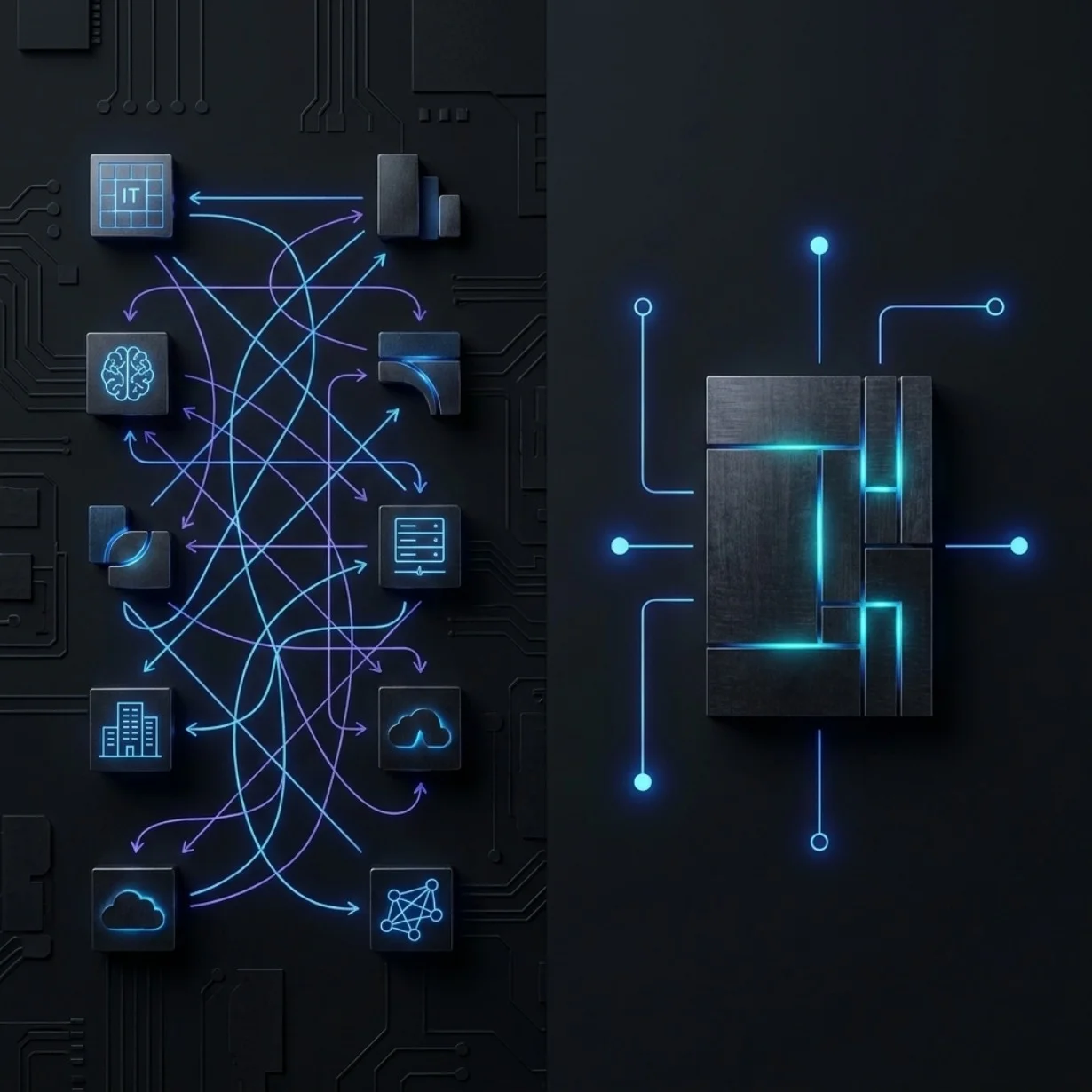
There is a widespread belief in the business world that it is best to have specialized vendors for every need: one for hardware, another for support, another for cloud, another for cybersecurity, another for the civil works of the data center, and another to develop the bot or artificial intelligence project.
The logic seems solid: each specialist does their job best. But in practice, this strategy generates one of the most costly and least visible problems of technology management in medium-sized companies: fragmentation.
The multi-vendor model: how it looks in practice
In most medium-sized companies that have been operating for several years, the technology vendor map has grown organically, not in a planned manner. This is not just about IT vendors: the complete map usually also includes those who build the physical infrastructure and those who develop artificial intelligence solutions. The typical picture includes:
A hardware vendor that sells equipment but does not provide support.
A technical support company that resolves incidents but does not know the complete infrastructure.
An internet or telecommunications provider.
A cloud partner, or the IT department itself managing accounts in AWS or Azure.
A cybersecurity company hired after a scare.
A civil works contractor who adapted the server room or data center, with no relationship to whoever operates it later.
A software developer or agency for internal applications.
A consultant or freelancer hired for the bot, AI assistant, or automation project, with no connection to the rest of the infrastructure.
Possibly, an external consultant trying to coordinate all of the above.
On paper, it seems reasonable. In operation, it is a constant source of friction, costs, and risks, and the problem worsens when physical infrastructure, IT systems, and artificial intelligence projects are managed by vendors who do not talk to each other.
The hidden costs of technology fragmentation
The shared responsibility problem
When something fails in an infrastructure managed by multiple vendors, no one is completely responsible. The network provider says the problem is the server. The server provider points to the cloud. The cloud provider says the local configuration is incorrect. And if the problem is in the electrical room or the data center's air conditioning, the IT vendor has neither the authority nor the knowledge to resolve it. The result: time lost in diagnostics and no problem resolved quickly.
The cost of contract management
Each vendor has its own contract, its own conditions, and its own renewal cycles. Multiplied by IT, construction, and AI development vendors, managing that consumes administrative resources that are not abundant in a medium-sized company.
The lack of a comprehensive vision
Each vendor knows only their part. No one has the complete picture: not of the physical infrastructure, nor of the systems, nor of the artificial intelligence projects being built on top of them. When a technological decision has to be made—migrating to the cloud, expanding capacity, implementing an AI assistant, building a new data room—no one can make a recommendation that considers the whole picture.
The risk of service gaps
There are always gray areas between one vendor and another. Infrastructure elements that no one actively manages because each vendor assumes it is the other's responsibility. These gaps are especially common on the boundary between civil works and IT operations, or between existing systems and new automation and AI solutions. That is where security incidents and silent failures happen.
What a comprehensive technology partner really brings to the table
A comprehensive partner is not simply multiple vendors operating under the same logo. It is an operation designed so that physical infrastructure, IT systems, and artificial intelligence work as a single, coherent whole:
Real continuity between stages: the same partner that adapts the physical space—civil works, cabling, power—is the one that later operates and supports the systems running on that infrastructure.
Technology decisions with a complete business vision, not fragmented by specialty.
A single escalation point when something fails, regardless of whether the source is in the network, the cloud, civil works, or an AI integration.
Ability to evolve: start with technical support and cloud, and scale toward automation, AI, or a new data center, without searching for or onboarding a different vendor for each step.
Financing models (renting, leasing) applicable to any type of project, not just equipment purchasing.
When does keeping multiple vendors make sense?
Keeping multiple vendors can make sense when:
The company is large enough to have a robust internal team acting as an integrator for IT, civil works, and AI vendors.
Technology needs are so specific and distinct that no single vendor has real capabilities in all of them.
There are contractual or regulatory conditions requiring specific vendors for certain services.
However, for the vast majority of medium-sized companies in Mexico—without a robust internal team and with broad and growing technology needs—the multi-vendor model generates more costs than it saves.
Aspect | Multiple vendors | Comprehensive partner (DITESA 360°) |
Point of contact | Multiple; diffused responsibility | Single; clear responsibility |
Infrastructure vision | Partial (each in their area: IT, civil works, or AI) | Complete and in real time, from civil works to AI |
Technological coherence | Inconsistent; possible friction | Designed as a whole |
Coordination time | High (constant internal burden) | Low (the partner coordinates) |
Incident resolution | Slow; fragmented diagnosis | Fast; complete vision |
Financial model | Multiple invoices and contracts | A single flexible agreement, applicable to IT, infrastructure, or AI |
The DITESA 360° model
DITESA is the only mid-sized integrator in Mexico that operates all three layers of business technology under a single contract: physical infrastructure, IT systems, and applied artificial intelligence. These three units work in a coordinated, not isolated, manner:
DITESA IT Solutions — the daily technology operation
Technology consulting and advisory services, managed services (MSP) with technical support, preventive monitoring and SLAs, hybrid and multi-cloud, cybersecurity, networks and communications, equipment acquisition, and renting and technology financing models.
InfraCore — the physical infrastructure supporting operations
Technological civil works, corporate architecture and remodeling, structured cabling and communications, power and critical infrastructure (UPS and backup), and server rooms and data centers, both edge and corporate.
ConversIA — artificial intelligence applied to business
Artificial intelligence for companies, automation and intelligent bots (RPA + AI), software and application development with integrated AI, systems and API integration (ERP, CRM, legacy), data, analytics and intelligence, AI governance and security, and proprietary SaaS products.
For a medium-sized company, this represents:
A single contract, a single point of contact, and a single invoice, regardless of whether the project is technical support, a data center, or an AI assistant.
A comprehensive vision of the entire technological infrastructure, from the civil works to the artificial intelligence model running on it.
The ability to scale from technical support to your own data center or an AI project, without changing vendors or having to explain the business from scratch again.
Financing and renting models applicable to any type of project, in any of the three units.
Signs that your vendor model needs a review
Do you currently have more than three active technology vendors, including IT, civil works, and AI development?
When something fails, does it take you more than an hour to know who to call?
Has one vendor ever blamed another when there was a problem?
Does your team spend significant time coordinating vendors instead of focusing on high-value projects?
If you answered yes to two or more, your vendor model is generating costs and risks that are not listed on any invoice.
Do you want to review how your technology strategy is organized?
At DITESA, we provide a free assessment of your current technological map: what you have, who manages it, where the gaps are—whether in physical infrastructure, IT systems, or artificial intelligence projects—and how it could be simplified without losing capability.
¿LISTO PARA DEJAR DE APAGAR FUEGOS?
Agenda una Discovery Session gratuita
Analizamos tu infraestructura actual, identificamos riesgos y te presentamos una propuesta concreta. Sin tecnicismos. Sin compromiso.
Agenda tu Discovery Session →

Ideas and Knowledge
Explore articles with ideas, trends, and practical learnings about technology, innovation, and digital growth.