The silent error that is holding back your company's growth: a poorly designed network
Discover why most companies in Mexico operate with networks that "just kept growing" without an architecture, and how this directly impacts their operations, security, and costs.

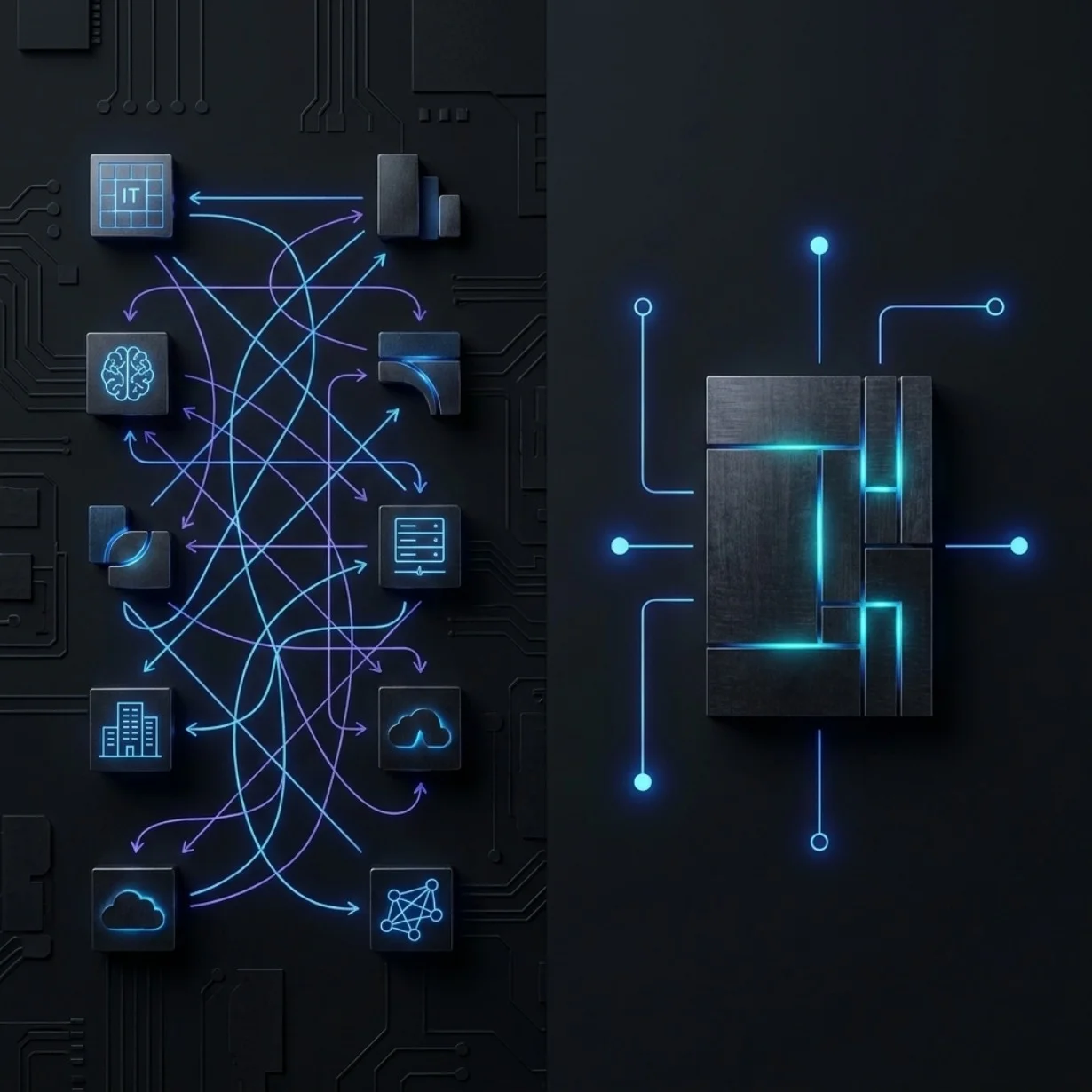
Most companies do not have a designed network. They have a network that just kept growing.
Users, devices, switches, access points are added... and everything seems to work. Until it doesn't.
And at that moment, the network stops being a technical issue and becomes an operational, financial, and strategic problem.
The false growth: when the network evolves without architecture
In many companies in Mexico, network infrastructure is not designed, it is adapted. New equipment is connected without planning, switches are added without a clear topology, and nobody stops to document what is connected, where, and why.
Imagine building a city without a blueprint. First a couple of houses, then a street, then a building, and eventually a hospital. Each piece makes sense at the time. But the whole has no structural logic, there is no zoning, there is no efficient distribution system.
That is exactly what happens with network infrastructure in most organizations. The most common symptoms are:
Switches stacked without a defined topology
WiFi access points added "where coverage was needed"
Servers connected to the same network as users and guest devices
No documentation of the existing architecture
No segmentation by critical areas or functions
The problem is not that this occurred. The problem is not knowing it, or knowing it and not acting.
The environment changed. Your network, probably did not.
The operational world of companies has changed radically in recent years. Three major transformations have redefined what an enterprise network needs to do today, and most existing infrastructures were not prepared for any of them.
Hybrid work and remote access. Users are no longer all in the office. They access critical systems from home, from clients, from airports. This requires the network to support secure VPNs, multi-factor authentication, and differentiated access policies. A flat network without segmentation cannot guarantee this securely.
Migration to cloud and hybrid environments. More and more companies are using platforms like Google Cloud Platform, Microsoft Azure, or Amazon Web Services to host applications, databases, or ERP systems. But if the local network is not designed to communicate efficiently with these environments, the result is latency, instability, and high operational costs.
Cyberattacks, control, and administration. Mexico is one of the countries in Latin America with the highest rate of cyberattacks on businesses. A flat network, without segmentation or access control, is the perfect scenario for an attacker who manages to enter through one point to propagate laterally throughout the entire organization without facing barriers.
The real consequences you are already paying for
A poorly structured network does not fail all at once. It degrades. And it does so in ways that directly impact the business, often without anyone identifying them as a network problem:
Constant slowness in systems and applications
Intermittent connectivity drops
Failures in critical applications at the worst times
Unproductive users waiting for the system to respond
Resource saturation without apparent cause
Greater exposure to cyberattacks without visibility into the real risk
And most importantly: when the network fails, the business stops.
The critical mistake: not segmenting the network
One of the most common—and most costly—problems is operating with a flat network. This means everything is connected to everything: administration, operations, personal devices, guests, servers. Without any barriers between them.
Without segmentation, any incident affects the entire organization. A compromised device does not remain contained: it propagates. A user with access to the guest network can, without anyone knowing, reach critical servers.
A modern architecture requires segmentation using VLANs, which allows to:
Separate traffic by functional area (administration, operations, guests, servers)
Apply differentiated access control by role
Prioritize critical traffic over trivial traffic
Contain any incident without it propagating to the rest of the organization
This is not sophistication. This is operational survival.
If you want to understand how this service is structured, you can review the Networks and Communications proposal from DITESA IT Solutions at https://www.grupoditesa.com.mx/it-solutions/redes-comunicaciones
The most expensive moment: correcting when you already depend on the network
This is where many companies react... too late. There is a window of opportunity to address these problems in a planned and economical way. That window closes when the network's operational dependency is so high that any intervention means interruptions.
Redesigning an operational network implies:
Interruptions in operation (night or weekend windows)
Complete reconfiguration of switches, routers, and access points
Possible replacement of equipment that does not support the new architecture
Re-engineering of security and access policies
High costs and critical times that directly affect the business
Correcting a poorly designed network can cost 5 to 10 times more than having designed it correctly from the start. Not to mention the operational cost of interruptions during the process.
DITESA + Cloud: an additional layer of efficiency with GCP
Today, the network no longer lives only inside the office. Companies are migrating to hybrid environments that combine local infrastructure with cloud platforms like Google Cloud Platform, Microsoft Azure, or Amazon Web Services. Applications, databases, and critical systems now depend on a proper integration between the local network and the cloud.
Without an appropriate architecture, latency increases, security is compromised, and operations become unstable. The cloud does not solve a poorly designed network problem: it amplifies it.
Recently, DITESA has strengthened its value proposition by integrating as a cloud provider and incorporating solutions on Google Cloud Platform as a key accelerator for its clients. This allows to:
Connect local infrastructure with cloud securely and efficiently
Optimize the performance of enterprise applications in hybrid environments
Implement scalable architectures prepared for growth
Improve the availability and redundancy of critical systems
Integrate AI and automation solutions on a solid technological foundation
The result is not just a better network. It is the technological foundation on which your business operates today and on which it will grow tomorrow.
How to know if your network needs an assessment?
Answer these questions:
Do you have up-to-date documentation of your network architecture?
Is there VLAN segmentation by functional areas?
Is your local network designed to integrate with cloud environments?
Do you have real-time visibility of traffic and connected devices?
Are your applications' response times consistent?
If you answered "no" or "I don't know" to two or more of these questions, your network probably needs an assessment.
Free Discovery Session — At no cost, no obligation
DITESA IT Solutions offers diagnostic sessions at no cost: a Discovery Session where we evaluate the current state of your network infrastructure, identify operational risks, and provide you with a clear roadmap of action.
No technicalities. No commitment. Just clarity on where you are and what you need to build a solid technological foundation.
Schedule your free Discovery Session at https://www.grupoditesa.com.mx/en/it-solutions
¿LISTO PARA DEJAR DE APAGAR FUEGOS?
Agenda una Discovery Session gratuita
Analizamos tu infraestructura actual, identificamos riesgos y te presentamos una propuesta concreta. Sin tecnicismos. Sin compromiso.
Agenda tu Discovery Session →
Ideas and Knowledge
Explore articles with ideas, trends, and practical learnings about technology, innovation, and digital growth.