Technology as a cost vs. technology as a competitive advantage: the shift that makes the difference
Technology is neither good nor bad on its own. What defines its impact on your business is the mindset from which it is managed: as an expense to be minimized, or as an asset to be activated.

The difference is not in the IT budget. It is in the mindset from which it is managed. And that mindset determines whether technology holds back or accelerates your company's growth.
There are two companies that invest exactly the same budget in technology. They are similar in size, operate in the same sector, and face the same market challenges. Five years later, one has gained market share, operates with greater efficiency, and makes decisions faster than its competitors. The other continues to solve the same problems, with the same systems, and feels that technology is a constant source of friction and expense.
The difference was not the budget. It was the mindset from which each managed its technology.
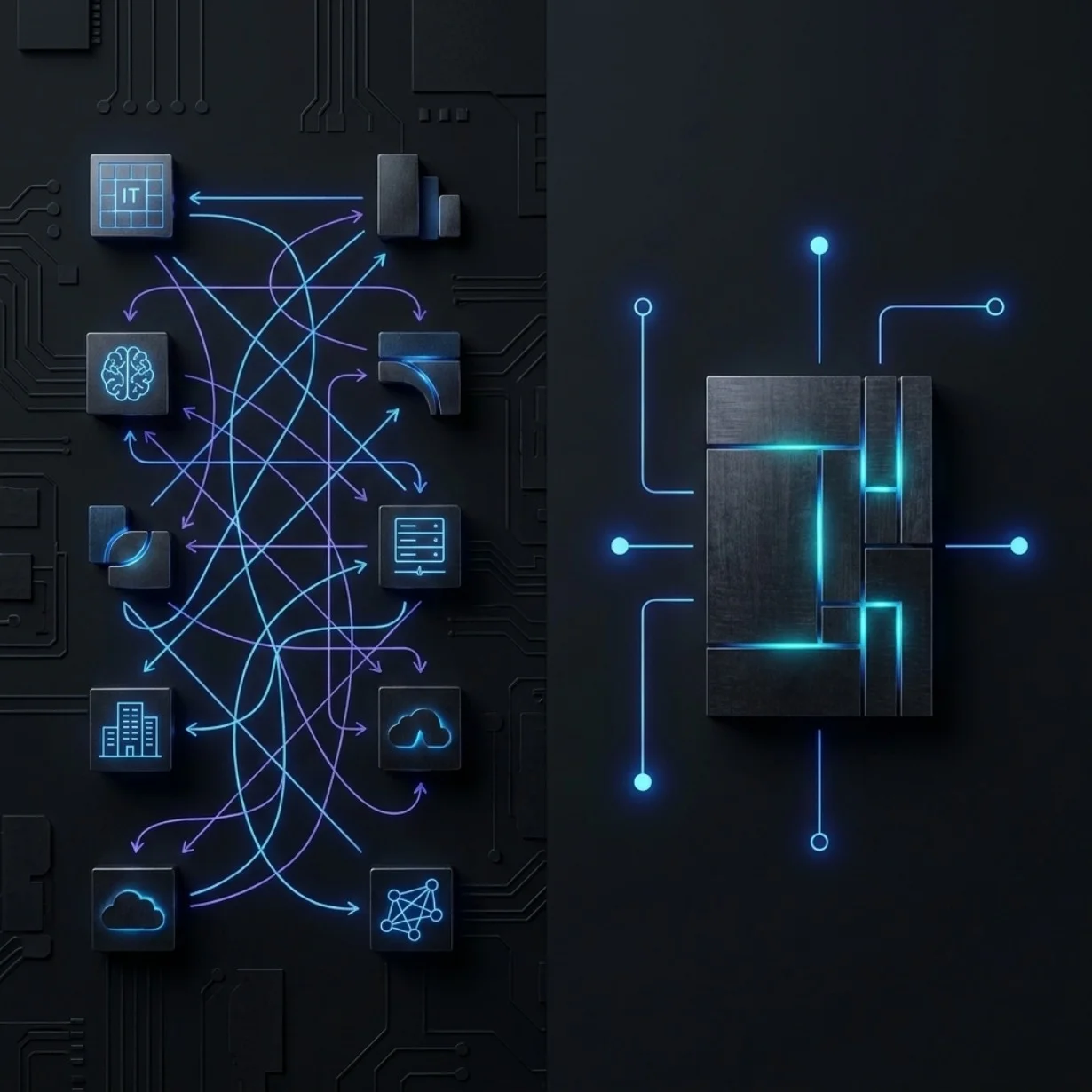
When technology is managed as a cost, the goal is to minimize it: cut bills, postpone renewals, hire the cheapest support available. When managed as a competitive advantage, the goal is to activate it: invest where it generates a return, build architecture that scales, align every technology decision with business objectives.
This article is not about technology. It is about the mindset that determines whether technology works for your company or against it.
35% | Companies with high-performing IT organizations see up to 35% more revenue growth and a 10% higher profit margin compared to the rest. Source: McKinsey & Company, “How high performers optimize IT productivity for revenue growth”, November 2024. mckinsey.com |
30% | The average company can optimize and reinvest up to 30% of its IT spend by improving technology productivity. Most do not do this because they manage IT as a cost, not as an investment. Source: McKinsey & Company, “How high performers optimize IT productivity for revenue growth”, November 2024. mckinsey.com |
What viewing technology as a cost looks like (and why it is so common)
The cost mindset is not a conscious decision. It is the natural result of managing technology without a strategic framework. It is recognized by its symptoms:
IT decisions are made by the finance department, not by the operations team or executive management
The dominant question is "how much does it cost?", not "what return does it generate?"
Technology renewals are postponed until the system stops working
There is no technology roadmap: purchases are made under pressure and reactively
The IT provider is evaluated by price, not by results or alignment with the business
Technology does not appear in business strategy discussions
This mindset has an apparent logic: if you do not generate visible value, you deserve the minimum budget. The problem is that it starts from a false premise: that technology is a neutral expense that can be cut without consequences. In today's economy, that premise is no longer sustainable.
«Minimizing technology spend does not reduce costs. It transfers the cost to the future, with interest.» |
The real cost of managing technology as an expense
The problem with the cost mindset is not philosophical. It is financial. And it manifests in concrete ways that directly impact the bottom line:
01. Speed of response to the market
When technological infrastructure is weak, launching a new product, adapting a process, or integrating a new channel takes twice as long. Competitors who have invested in solid architecture move faster, get there first, and capture the opportunity before it is available to others.
02. Cost of non-integrated systems
Every system that does not talk to the others generates manual work, transcription errors, and duplicated information. That invisible cost is paid every day, in working hours of people who should be generating value, not moving data from one sheet to another.
03. Executive decisions based on poor information
Without integrated and well-configured systems, reports arrive late, are incomplete, or are unreliable. Strategic decisions are made with past data or intuition. In fast-moving markets, this informational disadvantage is critical.
04. Talent attraction and retention
The most competent professionals do not want to work with obsolete tools or in chaotic technological environments. When a company's technology sends the message of "we don't invest in this," it also sends that message to the people you recruit.
05. Unmanaged operational risk
Postponing updates, operating with unsupported systems, and not investing in cybersecurity does not eliminate risk: it accumulates it. When that risk materializes —a critical outage, a security incident, a data loss— the cost far outweighs that of having invested preventively.
What viewing technology as a competitive advantage looks like
The competitive advantage mindset does not require more budget. It requires a different perspective on how that budget is allocated, justified, and evaluated. Companies that operate from this mindset share recognizable patterns:
Technology appears in leadership discussions as a cornerstone of strategy, not as an expense line
There is a technology roadmap with 12, 24, and 36-month horizons, reviewed quarterly
Investment decisions are justified by expected return, not just price
The technological architecture is designed to scale with the business, not just to survive the quarter
There is a technology liaison who translates technical complexity into business language for leadership
Technology is measured by its impact on speed, efficiency, and decision-making capacity
These companies are not necessarily large, nor do they have extraordinary budgets. What they do have is a technology management model that connects every peso invested with a measurable business outcome.
Technology as a cost | Technology as a competitive advantage |
It is cut when there is financial pressure | It is protected because its return is understood |
It is managed by a support provider | It is managed as a strategic function |
Decisions are made by finance | Decisions are made by leadership with technical advice |
There is no roadmap: it relies on reacting to problems | There is a roadmap: it relies on anticipation and planning |
The architecture grew without design | The architecture was designed to scale |
The provider is evaluated by price | The partner is evaluated by results and alignment |
Technology does not appear in strategy | Technology is part of the value proposition |
The role of the technology partner in this mindset shift
The shift from one mindset to the other rarely happens alone. It requires an external catalyst: someone with the technical perspective to assess the current situation, and the ability to translate it into the strategic language that leadership needs to make informed decisions.
A technical support provider cannot play that role. They are optimized to resolve incidents, not to connect technical architecture with growth objectives. A strategic technology partner, on the other hand, acts as an external IT director who guides executive decision-making with technical criteria and business vision.
That is precisely what DITESA IT Solutions does for its clients. We do not just manage infrastructure: we build the bridge between technology and business strategy.
You can review how we structure this strategic support model at https://www.grupoditesa.com.mx/it-solutions/servicios-administrados
From cost mindset to competitive advantage: a real project
A distribution company with operations in several cities in Mexico had spent years managing its technology on the bare minimum model: reactive support, unintegrated systems, and technology decisions made by finance based solely on price. The result was predictable: frequent downtime, costly manual processes, and leadership that did not trust its own reports.
The turning point
The company did not come to DITESA because of a crisis. They came because a smaller competitor was winning clients with response times and operational visibility that they could not offer. Technology had ceased to be a support issue and had become a visible competitive disadvantage.
The approach
DITESA did not start with an infrastructure proposal. We started with a diagnosis: which critical business processes depended on technology? Where were the bottlenecks? What executive decisions were being made with poor information? Based on that diagnosis, a technology roadmap was built with three horizons: stabilization, integration, and scalability.
The solution
On Google Cloud Platform infrastructure, DITESA designed the architecture that allowed for the integration of critical operational systems, ensuring:
System availability for all locations simultaneously
Real-time operational information for leadership
Processes that were previously manual automated with complete traceability
Architecture prepared to incorporate new tools without redesigning from scratch
OPEX financing model that converted the investment into a predictable monthly fee
Result In 18 months, the company went from operating in reactive mode to having complete, real-time visibility of its operations. Leadership made strategic decisions with reliable data for the first time. Technology stopped appearing in conversations as a problem and started appearing as an advantage. |
How to make the shift: the starting point
The shift in mindset does not require a total transformation all at once. It requires a clear starting point and guidance that ensures every technological decision is connected to the business. These are the three elements that must exist for the change to be sustainable:
01. An honest diagnosis of the current situation
Not of the infrastructure, but of how technology impacts critical business processes today: where it generates friction, where it causes delays, and where it leaves decisions without sufficient information.
02. A technology roadmap connected to business goals
Not an IT project list. A map showing how each technology investment contributes to a specific company goal: speed, efficiency, scalability, access to new markets.
03. A financing model that removes the barrier to entry
One of the reasons many companies get stuck in the cost mindset is that they perceive technology investment as an unattainable CAPEX. Renting and OPEX models remove that barrier: they allow access to updated technology without compromising liquidity, with a predictable monthly fee that is accounted for as an operating expense.
The question that defines the model
There is a simple question that reveals the mindset from which technology is managed in a company: when a market opportunity arises, is technology what makes it possible or what delays it?
The companies that have made the shift are not those with the biggest budgets. They are those that have decided that technology is a cornerstone of their strategy, not an expense line to minimize. And they have sought the right support to manage it that way.
Technology is not inherently expensive or cheap. It is expensive when it does not generate a return. It is cheap when it accelerates the business, improves decisions, and opens up opportunities that would otherwise not exist.
Free Discovery Session — No cost, no commitment How is your company managing technology today: as a cost or as an advantage? Do you have a technology roadmap connected to your business goals? Do you know what impact your current infrastructure has on your growth speed? If you do not have clear answers to these questions, we invite you to a free Discovery Session with the DITESA IT Solutions team. In 60 minutes we will assess your current situation, identify gaps, and show you what a technology management model aligned with your company's growth should look like. No technical jargon. No commitment. Just clarity. |
¿LISTO PARA DEJAR DE APAGAR FUEGOS?
Agenda una Discovery Session gratuita
Analizamos tu infraestructura actual, identificamos riesgos y te presentamos una propuesta concreta. Sin tecnicismos. Sin compromiso.
Agenda tu Discovery Session →
Ideas and Knowledge
Explore articles with ideas, trends, and practical learnings about technology, innovation, and digital growth.