The IT provider you have isn't the one your company needs (and you probably already know it)
There is a critical difference between an IT support provider that resolves tickets and a technology partner that builds architecture and aligns technology with your company's growth.

Undefined SOWs, ambiguous SLAs, and reactive support: the model slowing down growth without you noticing.
Most companies do not fail due to a lack of technology. They fail due to a lack of structure.
You have technical support. You have a provider that responds when something fails, restarts servers, resolves issues with the director's email, and installs antivirus when you ask.
And yet, you feel that technology in your company is not moving forward. That you are always putting out fires. That technology decisions are made reactively. That when you need to scale, you have to start from scratch.
You have support, but:
There is no clear scope of work (SOW)
There are no real service levels (SLAs)
There is no architecture
The problem is not technology. It is the model.
The model slowing you down without you noticing
Most companies in Mexico operate with an IT support model designed for another era: a provider that reacts to incidents, solves problems when they occur, and delivers closed ticket reports.
This model has three structural problems that directly impact the business:
Lack of clear scope (SOW — Statement of Work). What exactly is included in the service you contract? What is left out? In most IT support contracts, this is not precisely defined. The result is constant arguments over what is "within scope" and what is an additional service. Wasted time, friction, and, most importantly, issues that nobody addresses because they fall into no-man's-land.
SLAs that are not measured (or mean nothing). An SLA (Service Level Agreement) is a commitment to service levels: how quickly an incident is addressed, how quickly it is resolved, and what happens if it is not met. Many IT support contracts have defined SLAs on paper that no one monitors, reports, or enforces. If it is not measured, it does not exist.
Reactive support without architectural vision. The deepest problem: a traditional technical support provider is optimized to solve today's problem, not to prevent tomorrow's or to build the foundation for the day after. It addresses the symptom, not the cause. It does not design architecture. It does not evaluate systemic risks. It does not connect technology with business objectives.
The invisible cost that does show up in your results
It is not easy to quantify the cost of lacking technological structure. It does not show up on an invoice. But it does show up—quietly and spread out—in multiple places. Translated into money, it looks like this:
Unproductive hours due to slow or down systems. Every hour an employee cannot work due to a technical problem has a real cost. Multiplied by the number of affected employees and the frequency of incidents, the number quickly becomes significant.
Rework due to non-integrated system errors. When systems are not well integrated, information is duplicated, manually transcribed, and loses consistency. The cost in terms of labor hours and operational errors is constant.
Urgent and unplanned purchases. Without a technology roadmap, IT purchases are made under pressure: when something fails, when it is urgently needed, without time to evaluate options or negotiate terms. The surcharges for urgency are systematic.
Delayed decisions due to lack of information. In a company where systems are not aligned with operations, reports arrive late, are incomplete, or are unreliable. Management decisions are made with poor information or with delays that impact the business.
Unmanaged operational and security risk. Without a proactive risk assessment, security vulnerabilities and single points of failure in the infrastructure are not identified until they cause an incident. The cost of a security incident or a critical downtime far exceeds the cost of having prevented it.
Lacking IT structure is an ongoing hidden expense.
The real difference: technical support vs. technology partner
This is the distinction that sets apart companies that use technology from those that benefit from it.
A technical support provider reacts to incidents, addresses specific issues, operates with ambiguous SOWs and SLAs, and does not connect technology with business goals. Their value proposition is: we fix it when it breaks.
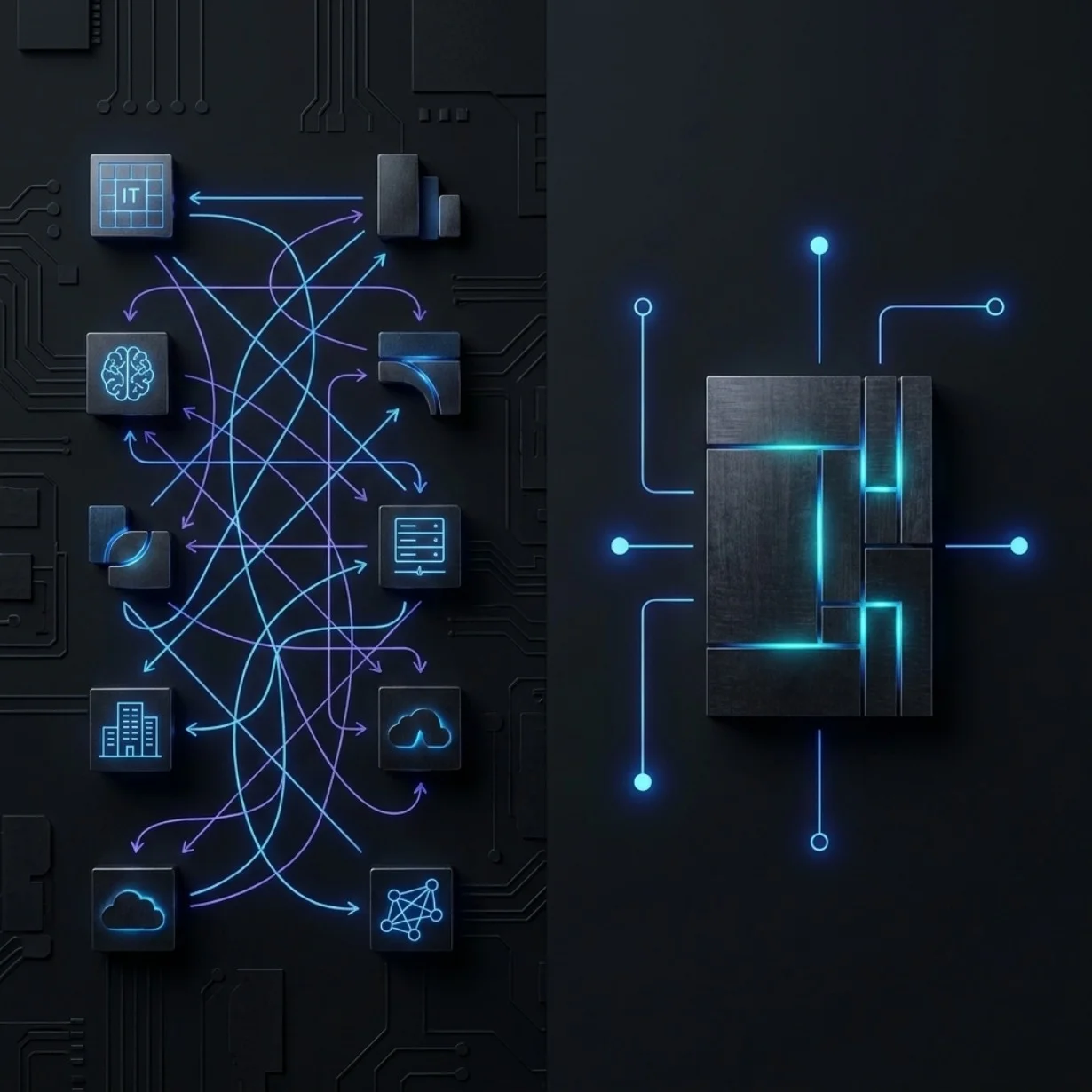
A strategic technology partner anticipates and plans, designs architecture, establishes clear and measurable SOWs and SLAs, aligns technology with business growth, and builds so that things do not fail. It is not support. It is external technology leadership.
The specific differences:
Defines architecture before implementing, not after something fails
Establishes clear, measurable, and monthly reported SOWs and SLAs
Aligns technology with business goals, not just open tickets
Anticipates problems and plans technological growth
Translates technical complexity into business language to guide executive decisions
You can review how DITESA IT Solutions structures this service model at https://www.grupoditesa.com.mx/it-solutions/servicios-administrados
When technology is mission-critical: a real case
To understand the difference between support and a technology partner, there is nothing better than a real project. A clinical organization needed to integrate its operations with MediTEX, a specialized system developed in Germany. What seemed like a technical implementation was, in reality, a high-criticality project.
The challenge
It was not just a technical implementation. The clinic needed:
Absolute stability in its operations, where any downtime directly impacted patient care
Integration of a highly specialized system with an external vendor in another country
A technology foundation prepared to scale without having to rebuild from scratch
Clarity on how technology impacted business growth
The solution
DITESA designed the project architecture and deployed a virtual machine within Google Cloud Platform, ensuring:
High availability of the clinical system
Secure access for all users in the organization
Efficient integration with existing clinical operations
A solid foundation for future growth without needing to redesign the architecture
The differentiator: global execution, local impact
One of the key success factors was the involvement of the DITESA Europe team. Thanks to this:
Communication with MediTEX in Germany was direct and efficient
Implementation times were significantly reduced
Technical interpretation errors between teams were minimized
Project costs were optimized by eliminating intermediaries
The true value: translating technology into business
But the value was not just in the execution. Throughout the process, DITESA acted as a strategic bridge:
Translating technical concepts into business language understandable to leadership
Guiding decision-making in each critical phase of the project
Advising on scalability and future evolution of the system
Aligning technology with clinical operations and growth objectives
It was not just about implementing a system. It was about building a foundation for business growth.
The result
Successful implementation of a critical system on time and on budget
Stable and secure operation from day one
Reduction in time and costs compared to the initial estimate
Infrastructure prepared to scale without redesign
What a well-structured service model must include
If you are evaluating changing or improving your IT support model, these are the minimum elements that any serious proposal must include:
Clear and detailed SOW. What services are included, how frequently, and under what conditions. What is out of scope and what is the process for handling additional requests. No ambiguity.
Defined, measured, and reported SLAs. Response and resolution times based on the criticality level of the incident. Escalation mechanisms. Monthly compliance reporting.
Proactive monitoring. Infrastructure must be continuously monitored before problems occur. Early alerts, preventive checkups, and planned updates.
Periodic strategic reviews. At least quarterly, a review to evaluate not only operational status but also the alignment of the technology architecture with business objectives.
Flexible financing model. A modern technology partner should offer leasing and financing options that allow turning CAPEX investments into OPEX, facilitating access to updated technology without compromising liquidity.
The time to change the model
The question is not whether you need a technology partner instead of a support provider. The question is how much longer your business can afford to operate without one.
Companies that have made this transition have not simply switched providers. They have changed models: from reacting to anticipating, from improvising to planning, from viewing technology as an expense to seeing it as a competitive advantage.
Free Discovery Session — No cost, no commitment
Does your current provider have a clear SOW? Do they report SLA compliance to you monthly? Do they have a technology roadmap for your company?
If the answer is no, we invite you to a free Discovery Session with the DITESA IT Solutions team. In 60 minutes, we will assess your current situation, identify gaps, and show you what a well-structured service model should look like for your business.
No technical jargon. No commitment. Just clarity on where you are and what you need.
Schedule your free Discovery Session at https://www.grupoditesa.com.mx/en/it-solutions
¿LISTO PARA DEJAR DE APAGAR FUEGOS?
Agenda una Discovery Session gratuita
Analizamos tu infraestructura actual, identificamos riesgos y te presentamos una propuesta concreta. Sin tecnicismos. Sin compromiso.
Agenda tu Discovery Session →
Ideas and Knowledge
Explore articles with ideas, trends, and practical learnings about technology, innovation, and digital growth.