


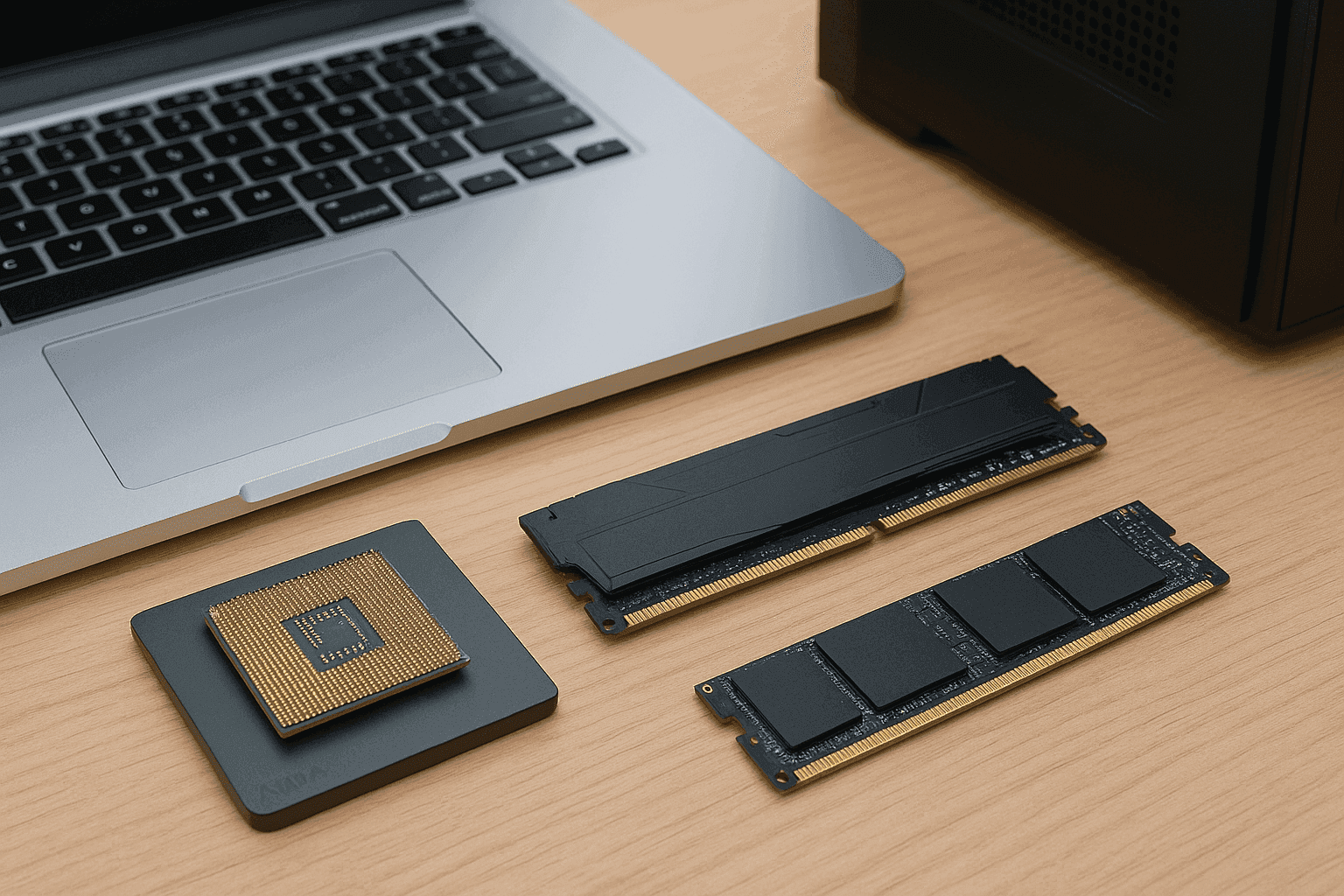
Computer Purchase Guide 2025: Best CPUs, RAM, and SSDs for Offices in Mexico
2025 Guide to Computers in Mexico: discover ideal CPU, RAM, and SSD options for offices with basic, good, and pro choices according to your budget.
In 2025, as offices in Mexico continue to digitize their operations and expand hybrid work, choosing the right IT infrastructure is essential.
Whether you are implementing systems across multiple branches or planning large-scale upgrades, you need clarity on which CPUs, memory, and storage options offer the most durability, performance, and value. This “2025 Computer Buying Guide” helps to demystify CPU naming conventions, how much RAM you really need, the differences between SSD and HDD, and when an integrated GPU is sufficient (or not) in an office environment.
Understanding CPU Nomenclature and Architecture in 2025
In 2025, the leading CPU manufacturers, Intel and AMD, continue to evolve their naming conventions, especially in hybrid and AI-enabled generations.
Intel (Arrow Lake / Core Ultra era):
The 2024–2025 desktop generation from Intel uses the Arrow Lake architecture and now employs the Core Ultra branding for high-end models.
Example: Core Ultra 9 285K / 285 – includes performance cores (P cores) + efficiency cores (E cores), integrated Xe GPU, and AI accelerators.
For office machines, pay attention to the suffixes “K” / “KF” / “F” / “T”.
K = unlocked
F = no iGPU
T = low power
Additionally, Intel offers vPro / vPro Enterprise variants with business features such as remote management, virtualization support, and ECC memory.
AMD (Zen 5 / Ryzen AI era):
The main AMD line in 2025 is based on the Zen 5 architecture (sometimes referred to as “Nirvana” or Ryzen AI).
The Ryzen 5, Ryzen 7, and Ryzen 9 ranges remain. The “G/GE” suffix usually indicates integrated graphics (APU).
AMD is also preparing Zen 6 for 2026, but it is not yet standard.
Workstation / High-End:
For specialized tasks (heavy rendering, virtualization, engineering), AMD offers Threadripper PRO; the new 9000 series has been announced for 2025.
But for typical offices (office software, browser, ERP, light applications), these models are not needed.
How Much RAM is Sufficient in 2025 for Office Use?
Office workloads typically include document editing, spreadsheets, email, web browsing (many tabs), light occasional multitasking, and in IT environments, virtual machines or containers.
Here is a guideline:
Level | Recommended RAM | Use Cases |
|---|---|---|
Basic | 16 GB DDR5 (dual channel) | Standard office use: Office applications, browser, light multitasking. |
Good | 32 GB | Heavier multitasking, large Excel models, multiple virtual machines, room for the future. |
Pro / Future-Proof | 64 GB | For advanced users, development machines, heavier virtualization, long update cycles. |
In 2025, RAM prices are stabilizing, although 64 GB remains a premium option. For mass implementations in offices, 16 GB is widely sufficient, with the possibility to expand to 32 GB later if needed.
A dual channel configuration (two modules) is recommended instead of a single large module, for bandwidth benefits.
If your CPU or platform supports ECC memory (especially in workstations or servers), consider ECC for mission-critical systems.
Advice for IT Planners / Bulk Buyers in Mexico
Volume Discounts and Localization: Buying 50–100+ units can give you a discount of 15–30% through local distributors.
Warranty and Support: Prioritize business models (SKUs) with next business day onsite support, extended warranties, and spare parts availability.
Power and Cooling Margins: In warmer Mexican offices, leave a margin (PSU, airflow) — avoid running components at 100% in standard cases.
Commonality of Parts: Use the same RAM modules, SSD models, and power supplies across your fleet to simplify maintenance.
Firmware and BIOS Management: Prefer motherboards with remote / out-of-band management (e.g. Intel vPro, AMD DASH) for patches and remote recovery.
Future Preparation: Even if you start with 16 GB or a 512 GB SSD, choose motherboards/laptops that allow upgrades to 32 GB+ or 1 TB+.
SSD vs HDD and Hybrid Storage
In 2025, the choice is usually quite simple:
SSD (NVMe / PCIe 4.0 / 5.0): Here should be the boot, applications, operating system, and active files. The speed gains are huge for system responsiveness.
HDD (7200 rpm / enterprise disks): Used for bulk storage, backup files, and archiving.
Hybrid / Tiered Storage: Useful when a server serves many users; a fast SSD as cache in front of large capacity HDDs can be very cost-effective.
For office desktops and laptops, I strongly recommend a 256 GB to 1 TB NVMe SSD as the primary drive.
For roles that handle a lot of data (e.g., local file servers), they can be combined with slower HDDs for greater capacity.
Integrated GPU (iGPU) vs Dedicated GPU for Office
Most office positions (word processing, spreadsheets, video calls, dashboards) do not require dedicated GPUs.
Modern integrated GPUs (Intel Xe, AMD RDNA iGPUs) are quite capable for up to two screens, 4K output, video conferencing, and light video playback. Therefore:
Basic and Good Levels: use CPUs with iGPU to reduce costs.
Pro / CAD / design / GPU-accelerated tasks: add a discrete GPU only if necessary.
Note: If you purchase a CPU with the suffix F (on Intel) or a “no iGPU” version by mistake, you will need a dedicated GPU solely to get video, avoid this in general offices unless strictly required.
Configuration Examples for Mexico (Desktop and Laptop)
Below are examples of basic, good, and pro configurations for 2025.
Prices are estimated in MXN (mid-2025) based on local retailers.
Desktops
Level | CPU + iGPU | RAM + Storage | Graphics | Approx Price (MXN) | Notes |
|---|---|---|---|---|---|
Basic | AMD Ryzen 5 (with iGPU) | 8 GB DDR5 + 512 GB NVMe SSD | Integrated | ~ $6,500 – $8,000 | Minimum office tasks |
Good | Intel Core Ultra 5 / Ryzen 7 | 16 GB DDR5 + 1 TB SSD | Integrated iGPU | ~ $12,000 – $16,000 | Balanced daily performance |
Pro | Intel Core Ultra 7 / Ryzen 9 | 32 GB DDR5 | Optional discrete GPU | ~ $22,000 – $30,000+ | Advanced users, VMs, analytics |
Laptops
Examples of laptops currently listed in Mexico (Office Depot / OfficeMax, etc.) as a reference:
Base Laptop: Asus Vivobook Go with i3, 8 GB + 512 GB — around MXN $6,999
Good Laptop: Asus Vivobook 15 with Core i5, 16 GB + 512 GB — approx. MXN $14,599
Pro Laptop: Lenovo ThinkPad T16 Gen 2, Ryzen 7 PRO, 32 GB + 1 TB — approx. MXN $30,609 (on promotion)
From Specifications to Strategy: Why Partnering with Experts Like DITESA Matters
In 2025, choosing technology is not just about specs, but about streamlining your team. The right CPU, RAM, and SSD drive productivity, and an expert partner in hardware and transformation is key.
That’s why many companies in Mexico trust DITESA, a leader in IT with over eight decades of experience, providing hardware, leasing, and digital solutions to keep businesses adaptable and competitive. Discover how DITESA can help you at grupoditesa.com.mx.



Ideas and Knowledge
Explore articles with ideas, trends, and practical learnings about technology, innovation, and digital growth.