Developing custom software vs. implementing a SaaS: when each option makes sense
Does your company need custom software or a standard SaaS? We analyze the key factors to make the right decision: costs, timelines, customization, and when custom development truly provides a competitive advantage.
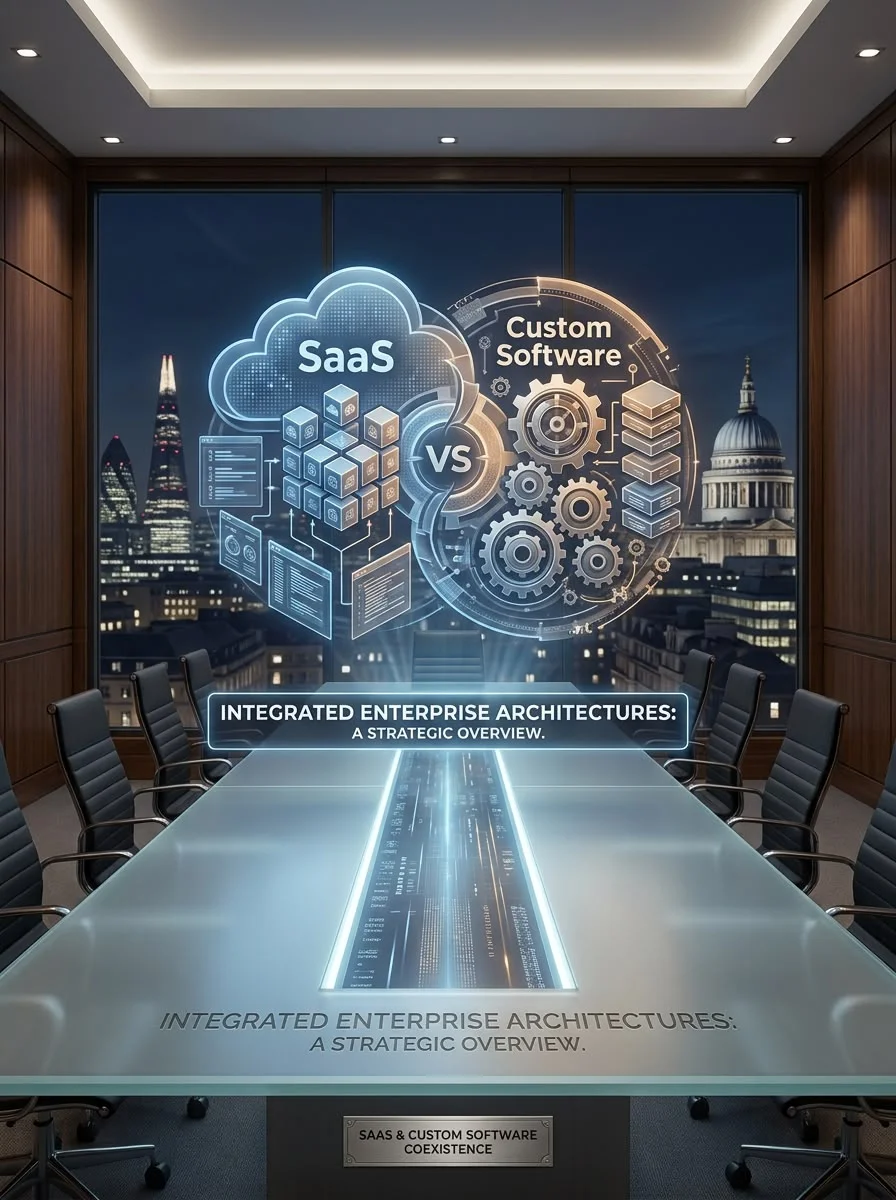
More and more medium-sized businesses in Mexico are facing a question that previously only large corporations asked themselves: do we build our own tool or do we use a standard solution available on the market?
The question seems technical, but it is fundamentally a business problem. The wrong answer can cost hundreds of thousands of pesos, months of frustrated development, or years tied to a platform that does not adapt to how your company operates.
What is SaaS and why it has become so popular
SaaS (Software as a Service) is any application delivered as a service over the internet, with a monthly or annual subscription model. Examples you already know: Salesforce, HubSpot, SAP Business One Cloud, Microsoft 365, Slack.
Real advantages of the SaaS model
Fast implementation: it can be up and running in days or weeks, not months.
Low initial cost: there is no capital investment in development. A subscription is paid from day one.
Updates included: the provider continuously maintains and improves the platform.
Provider support: if something fails, the provider is responsible for resolving it.
Scalability: most allow adding users or modules as you grow.
Limitations that are rarely discussed before buying
Limited customization: if your processes are very specific, SaaS may force you to adapt to it, not the other way around.
Provider lock-in: if the platform changes, increases prices, or is discontinued, your business is affected.
Data out of your control: in regulated sectors (health, finance, legal) it can create compliance issues.
Long-term cumulative cost: a $500 USD/month subscription is $30,000 USD in five years.
What is custom software development and when does it bring real value
Custom software is an application built specifically for the processes, workflows, and needs of a particular company. Once built, the company owns the code.
Advantages of custom development
Exact adaptation to business processes: the software does exactly what the business needs, without compromises or workarounds.
Frictionless integration: it can connect with existing systems — ERP, CRM, production platforms — in a way that standard SaaS sometimes does not allow.
Code and data ownership: the company fully controls the platform.
Evolution according to the business: the platform can be expanded and scaled as the company evolves.
Costs and risks to keep in mind
Higher initial investment: poorly scoped projects are the main cause of budget overruns.
Delivery time: depending on the complexity, it can take anywhere from three to twelve months before having something in production.
Ongoing maintenance: unlike SaaS, proprietary software needs active maintenance for security updates and bug fixes.
The most common mistake: developing what already exists
One of the most expensive mistakes medium-sized companies make is investing in custom development to solve something that a standard SaaS already solves well, faster, and cheaper.
A basic CRM, a task management system, an internal communication platform: these are all problems that the SaaS market has already solved thousands of times. Custom development adds real value when it solves something that SaaS cannot:
Very specific industry operational processes (custom logistics, proprietary production flows, complex quoting).
Integrations between legacy systems that no standard SaaS supports.
Proprietary digital products that the company wants to offer to its customers.
High-value automations that combine multiple internal systems.
A third way: Customized SaaS with integration
There is a middle ground that many companies do not consider: taking a SaaS platform as a base and customizing or extending it through specific development to cover the gaps that the standard solution does not address.
This approach combines the speed and cost of SaaS with the flexibility of custom development for those processes that truly need it. It is the smartest path when SaaS covers 80% of processes correctly and the remaining 20% is differential.
Quick guide to decide
Criterion | Use SaaS when... | Develop custom software when... |
|---|---|---|
The process | Is standard; a mature solution exists in the market | Is unique or differential; no SaaS solves it |
Speed | You need to implement in weeks | You can wait 3 to 12 months |
IT Team | Is small; cannot manage proprietary software | Has the maturity to maintain proprietary platforms |
Competitive advantage | There is no differentiation in that process | The process is a business differentiator |
Initial budget | Is limited | The ROI of the development is justified |
Do you have a process that needs a technological solution and you don't know which is best?
At ConversIA, DITESA's AI and software development unit, we perform this analysis with you: we evaluate your processes, identify what exists on the market and what requires custom development, and present you with a concrete proposal with real costs.
Learn about ConversIA services at:
¿LISTO PARA DEJAR DE APAGAR FUEGOS?
Agenda una Discovery Session gratuita
Analizamos tu infraestructura actual, identificamos riesgos y te presentamos una propuesta concreta. Sin tecnicismos. Sin compromiso.
Agenda tu Discovery Session →

Ideas and Knowledge
Explore articles with ideas, trends, and practical learnings about technology, innovation, and digital growth.