


What are the 4 most common use cases of Artificial Intelligence in companies?
Discover the 4 most common uses of Artificial Intelligence in companies: chatbots, predictive analytics, internal automation, and content generation.
Artificial Intelligence (AI) has stopped being a futuristic promise and has become a real, efficient, and cost-effective tool.
Today, companies of all sizes are integrating AI to reduce costs, accelerate processes, and generate more revenue. But… where to start?
Here we share the 4 most common and accessible use cases that any business can implement to begin its digital transformation.
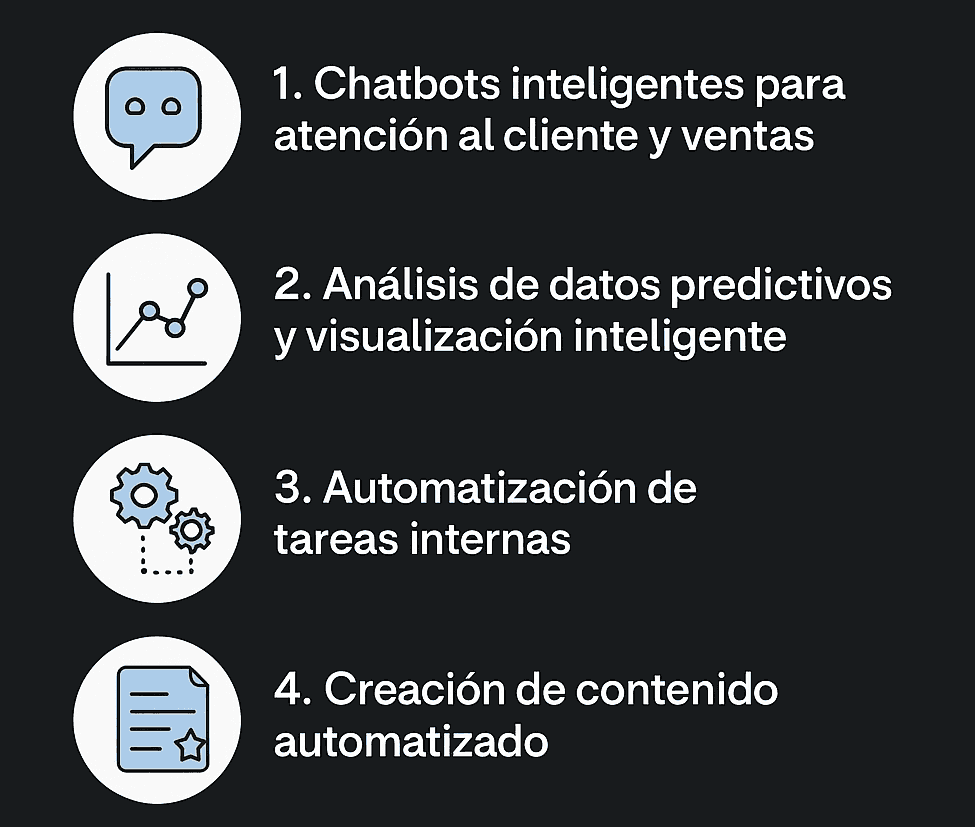
1. Intelligent chatbots for customer service and sales
Does your team waste time answering the same questions over and over again?
Artificial intelligence has revolutionized the way companies communicate with their customers, and intelligent chatbots are the clearest evidence.
With a well-trained chatbot, you can automate a large part of customer service and the sales process, providing immediate, accurate, and personalized responses. These virtual assistants not only interact with users, they also understand context, learn over time, and guide the customer toward the desired action.
💬 What can AI chatbots do?
Answer frequently asked questions in a natural and conversational way.
Guide the user through a purchase or service request process.
Automatically qualify leads and send them to the sales team.
Integrate with CRM, e-commerce platforms, WhatsApp, and social media.
📌 Real example: An online store can use a chatbot to recommend products, resolve shipping questions, and close sales automatically outside of business hours.
🔗 At Grupo Ditesa, we help companies implement conversational assistants specifically trained for their business, integrated with tools like Zapier, Make, or HubSpot.
💡 Impact:
Increased customer satisfaction.
Reduction of operational burden in customer service areas.
Automated but human-like conversations.
2. Predictive data analysis and intelligent visualization
Do you have valuable information in your company… but don’t know how to leverage it?
One of the most powerful uses of artificial intelligence lies in predictive analysis. Instead of simply showing what has already happened, AI can help you anticipate what is going to happen, based on the data you already have.
This type of analysis allows companies to make more informed decisions, reduce risks, and detect opportunities that would otherwise go unnoticed.
📊 What can be automated with AI in this area?
Identify buying patterns, customer churn, or decline in sales.
Create dynamic dashboards that show insights in real time.
Predict behaviors based on customer history.
Trigger alerts or automated flows based on certain conditions.
📌 Real example: An AI system connected to your customer database can detect which users are about to leave your service and automatically send a personalized retention campaign.
💡 Impact:
Faster decision-making based on real data.
Savings on poorly targeted campaigns or non-return investments.
3. Automation of internal tasks
How much time does your team waste on repetitive tasks that don’t add value?
From sending emails to updating systems, many companies spend hours on processes that could be completely automated.
AI allows you to free your team from mechanical tasks so they can focus on what is truly strategic. Additionally, by reducing human intervention, errors are minimized, and speed is gained.
⚙️ What can be automated internally with AI?
Automatic classification and response of emails or tickets.
Updating records in CRMs, spreadsheets, or internal systems.
Generation and sending of periodic reports.
Data synchronization between different platforms.
📌 Real example: A salesperson can schedule a meeting and automatically send a confirmation email, create the event in the calendar, and log the activity in the CRM… all without clicking.
🔧 At Grupo Ditesa, we design automation flows tailored to your current tools, whether it's Gmail, Notion, Salesforce, HubSpot, or custom systems.
💡 Impact:
Time savings and increased productivity.
Elimination of repetitive tasks.
Reduction of human errors and duplications.
4. Automated content creation (from idea to publication)
Can you imagine having content for your blog or social media created and published without lifting a finger?
With AI, that is already possible. You can not only generate text, but also automate the entire content marketing process.
🎯 What can be automated?
Generating ideas based on keywords or frequently asked questions.
Writing blogs and copy optimized for SEO or engagement.
Designing images with artificial intelligence.
Automatic scheduling and publishing on social media (Instagram, LinkedIn, Facebook, etc.).
📌 Real example: You can connect tools like ChatGPT, Canva with AI, Zapier, and Buffer to create a system that generates and publishes content daily without manual intervention.
💡 Impact:
Time and resource savings for the marketing team.
Greater frequency and consistency in content strategy.
The ability to create multiple versions adapted to different channels.
Conclusion – Where should your company start?
AI does not require large investments or complex technical teams. What you need is clarity in your current process and a use case with real impact.
At Grupo Ditesa, we help you identify those processes and propose practical, fast, and tailored solutions for your business.
📩 Do you want to know how to implement AI in your company?
Schedule a free diagnostic session with our digital transformation team.
📍 If you want an immediate response, message us on WhatsApp!



Ideas and Knowledge
Explore articles with ideas, trends, and practical learnings about technology, innovation, and digital growth.