Canon vs HP Printers 2025: Which printer better fits Mexican offices?
Are you looking for the perfect office printer in Mexico? Our Canon vs HP 2025 guide helps you choose based on quality, cost, and productivity.
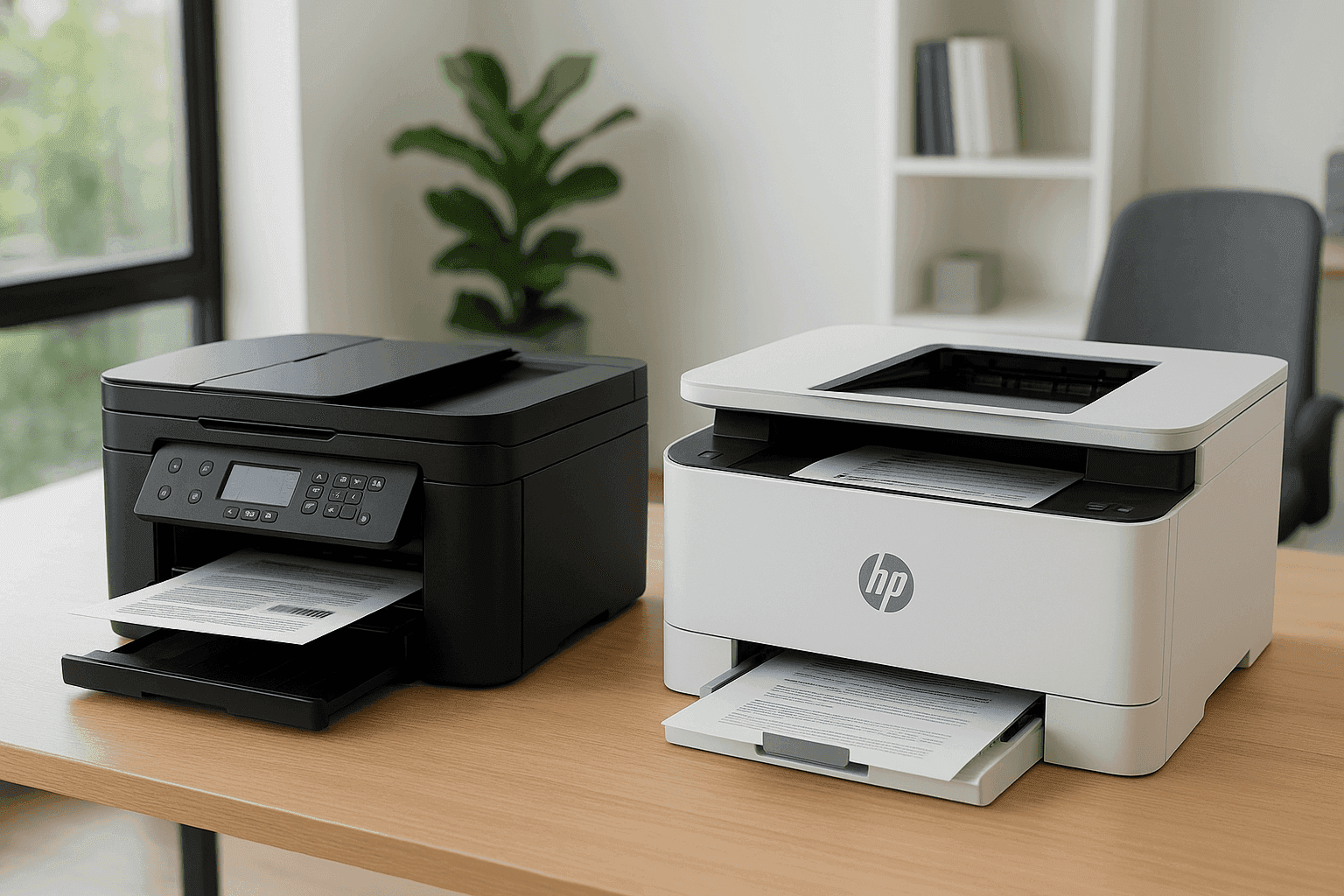
Choosing the right printer for your office in 2025 goes beyond brand loyalty: it is about balancing cost, speed, reliability, and functionality. For small and medium offices in Mexico, Canon and HP remain the top contenders, each offering models designed for modern workspaces.
From print speed and color quality to automatic document feeders (ADF), duplex printing, WiFi connectivity, and driver support, the choice can significantly impact productivity and operating costs.
In this guide, we compare Canon vs HP printers in 2025 head-to-head, including total cost of ownership (TCO) scenarios for periods of 12 and 36 months in MXN, helping you make an informed decision for your office.
Cost of printing per page
Canon Printers:
Canon printers generally offer competitive costs per page, especially in their multifunction inkjet devices. Black and white prints average between MXN 1.5–2 per page, while color pages range between MXN 4–5. Canon's high-yield cartridges and models with refillable tanks can further reduce costs in offices with high print volumes.
HP Printers:
HP laser printers typically excel in black-and-white printing, with costs of approximately MXN 1–1.8 per page. Color printing is slightly higher, between MXN 4.5–6 per page. HP's Instant Ink subscription in Mexico can lower the costs of frequent color printing, but the service may commit offices to recurring payments.
Verdict:
For budget-conscious offices that frequently print in color, Canon inkjet or tank printers may be more economical. HP laser printers are better suited for high-volume black-and-white printing.
Speed (Pages per minute)
Printer Type | Black and White (ppm) | Color (ppm) |
|---|---|---|
Canon ImageClass LBP | 28 | 25 |
Canon Pixma Series G | 13 | 10 |
HP LaserJet Pro | 30 | 28 |
HP Color LaserJet | 23 | 22 |
Verdict:
HP laser printers generally offer higher speeds in both B/W and color, which is crucial for offices with high print volumes. Canon's color tank printers are slower but provide better cost-effectiveness per page.
Color Quality
Canon:
Canon is widely recognized for its vibrant and accurate color reproduction, making it ideal for marketing materials, presentations, and photographs in offices.
HP:
HP color laser printers produce sharp text and decent graphics, although subtle color gradients may appear less saturated compared to Canon.
Verdict:
For documents where color is critical, Canon wins. For standard office graphics, HP is sufficient.
Automatic Document Feeder (ADF) and Duplex
Canon:
Most mid-range Canon multifunction printers include a 35–50 sheet ADF and double-sided scanning. Duplex printing speed is moderate, typically between 6–8 ppm for double-sided prints.
HP:
HP offers greater ADF capacity (50–100 sheets) and faster duplex printing, often integrated even in smaller models.
Verdict:
For high-volume document scanning and double-sided printing, HP provides better performance.
Connectivity and Drivers
Canon:
Canon supports WiFi, Ethernet, AirPrint, and Mopria. The drivers are generally stable on Windows and Mac, although support for Linux is limited. Canon's mobile printing apps are user-friendly for offices in Mexico.
HP:
HP excels in connectivity, offering WiFi Direct, cloud printing, AirPrint, and Google Cloud Print. Its drivers are solid and regularly updated for Windows, Mac, and Linux. The HP Smart app allows easy printing and monitoring from mobile devices.
Verdict:
HP has a slight edge in connectivity flexibility and driver support.
Service and Support in Mexico
Canon:
Canon has a strong service network in Mexico, with authorized centers in major cities. Response times are reliable, although repair costs for multifunction devices may be higher.
HP:
HP has an extensive service and support network, with quick on-site repairs for business customers and proactive maintenance plans. Warranty extensions are available at competitive prices.
Verdict:
HP has a slight advantage in service speed and extended business support.
Total Cost of Ownership (TCO)
To evaluate long-term expenses, we compare a mid-range office printer in 12 and 36-month scenarios (MXN):
Printer Model | TCO 12 Months (MXN) | TCO 36 Months (MXN) | Notes |
|---|---|---|---|
Canon Pixma G6020 | 12,500 | 32,000 | High-yield tanks, low color cost |
Canon ImageClass LBP6230 | 14,000 | 35,500 | Quick black and white, moderate color cost |
HP LaserJet Pro M404dn | 13,500 | 34,500 | Fast in B/W, low maintenance |
HP Color LaserJet Pro M255dw | 16,500 | 40,000 | Moderate color quality, fast duplex |
Observation:
Canon's tank printers stand out for their cost-efficiency in color printing over the long term. HP's monochrome lasers offer lower maintenance and higher speed, making them ideal for offices with heavy document loads.
Final Recommendation
Choose Canon if:
Color print quality is a priority (marketing, presentations).
The office volume is moderate and needs to minimize cost per page.
Your team values mobile printing from smartphones and tablets.
Choose HP if:
The office prints large volumes of black and white documents.
Fast duplex printing and high ADF capacity are required.
Strong local support and updated drivers are critical for uninterrupted operations.
Invest Smartly, Operate Smarter
For Mexican offices in 2025, the “best” printer is not about brand loyalty, but the total cost of ownership, uptime, and adaptability.
Canon may offer durability for creative equipment, while HP can reduce downtime in fast-paced offices. But buying outright is not always the only solution. With hardware leasing, IT infrastructure, and managed services from DITESA, businesses of all sizes can remain flexible, scale faster, and keep technology costs predictable.
Whether you choose Canon or HP, DITESA ensures that your investment is aligned with long-term digital transformation.
¿LISTO PARA DEJAR DE APAGAR FUEGOS?
Agenda una Discovery Session gratuita
Analizamos tu infraestructura actual, identificamos riesgos y te presentamos una propuesta concreta. Sin tecnicismos. Sin compromiso.
Agenda tu Discovery Session →


Ideas and Knowledge
Explore articles with ideas, trends, and practical learnings about technology, innovation, and digital growth.